
Nature’s Production Factory: Synthetic Polymerization vs. Dehydration Synthesis
Modern industry expends enormous amounts of energy to produce the materials that hold our buildings together and insulate them. Synthetic resins, polyurethanes, and epoxies, marketed today as revolutions on construction sites, are actually products of chemical violence. Synthetic polymerization is a brute-force engineering approach that forces molecules to bond under high temperatures, explosive pressures, and heavy metal catalysts.
However, the future of material science lies not in the smokestacks of petrochemical plants, but in the silent, zero-waste, room-temperature cellular factories of forests and microorganisms. The secret of these biological factories is nature’s most elegant construction mechanism: Dehydration Synthesis.
1. The “Violence” of Synthetic Polymerization and Economies of Scale
Producing a synthetic polymer (e.g., epoxy, PVC, or polyurethane) means forcing molecules into a structural form they naturally resist. Petrochemical monomers are highly stable and do not inherently seek to bond with one another. To break this resistance, the synthetic industry utilizes massive reactors, applying hundreds of degrees of heat and extreme pressure. Yet, heat and pressure alone are insufficient; toxic initiators (peroxides) and heavy metal catalysts must be introduced into the system to trigger the reaction.
The Economy of Scale Illusion: If this method is so primitive and harmful, why does it still dominate the market? The answer is found not in the engineering superiority of synthetic plastics, but in the illusion of Economies of Scale. The plastics industry was initially established to monetize the waste gases (ethylene, propylene) of oil refining. Thanks to a century-old fossil fuel infrastructure, massive global reactors, and government subsidies, production costs have been artificially driven down to pennies. The true cost of health and environmental destruction (Externalized Costs) is never reflected on the product’s price tag.
1. Petrochemical Waste
Inactive, highly stable monomers left over from oil refining that naturally resist bonding.
2. Thermodynamic Violence
Molecules are forced to fuse using extreme heat, explosive pressure, and toxic heavy metal catalysts.
3. Defective Polymer (VOC)
Unreacted toxins (SVOCs) and catalyst residues trapped in the matrix begin to continuously off-gas indoors.
2. Nature’s Elegance: Dehydration Synthesis
To construct massive, ultra-durable macromolecules (proteins, cellulose, lignin, DNA), nature requires none of the thermodynamic violence utilized by the synthetic industry. Nature’s production mechanism is scientifically known as Dehydration Synthesis (Condensation Polymerization).
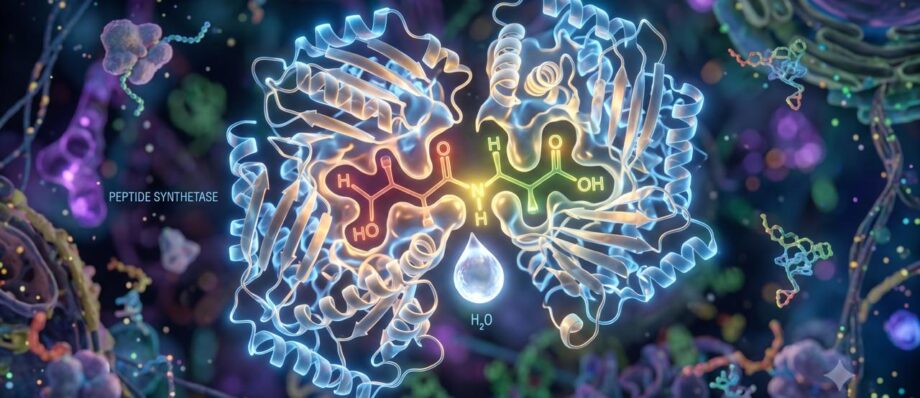
The “Lock-and-Key” Fit of Enzymes: The architects of this biological process are enzymes. Enzymes possess a geometric perfection (an “active site”) that only accepts specific molecules. When bringing two monomers together, the enzyme strips a Hydroxyl (-OH) group from one and a Hydrogen (-H) atom from the other. These stripped components combine to form H2O (Water), which is safely expelled from the system. The remaining molecules are locked together with an incredibly strong, flawless covalent bond.
- This process does not require high heat; it occurs silently and efficiently at room temperature (20°C – 37°C).
- There is zero reliance on toxic chemicals or heavy metals; the process is entirely governed by highly specific, biocompatible enzymes.
- The byproduct of the reaction is not toxic off-gassing or microplastic waste, but simply pure water.
1. Natural Monomers
Natural building blocks equipped with Hydrogen (-H) and Hydroxyl (-OH) groups at their extremities.
2. Enzymatic Bonding
Enzymes capture molecules via a lock-and-key fit at room temperature, stripping (-H) and (-OH) groups.
3. Biopolymer + Pure Water
A 100% biocompatible material with flawless covalent bonds is formed, expelling H2O (Water) as a byproduct.
3. The True Kings of Building Biology: Lignin and PHA
Once we comprehend the structural integrity of materials built through dehydration synthesis, the reliance on synthetic plastics in modern architecture ceases to look like an engineering success and reveals itself as a fundamental lack of vision. Setting the gold standard for Biocompatibility, two miraculous natural polymers will shape the future of architectural specification:
Conclusion: Surrendering to Biological Intelligence
Architecture and structural engineering can no longer sustain modern environments using synthetic poisons produced by brute force in petrochemical laboratories. The true quality and health profile of a building are measured by the biochemical elegance of the bonds that hold its materials together. When flawless products of enzymatic processes—such as Lignin and PHA—are available, continuing to suffocate our living spaces with covalent plastics boiled at high temperatures and forced together with toxic catalysts is not a necessity; it is a severe engineering failure. True material innovation is not about mimicking nature’s factory, but integrating its already perfect production lines directly into architectural design.