
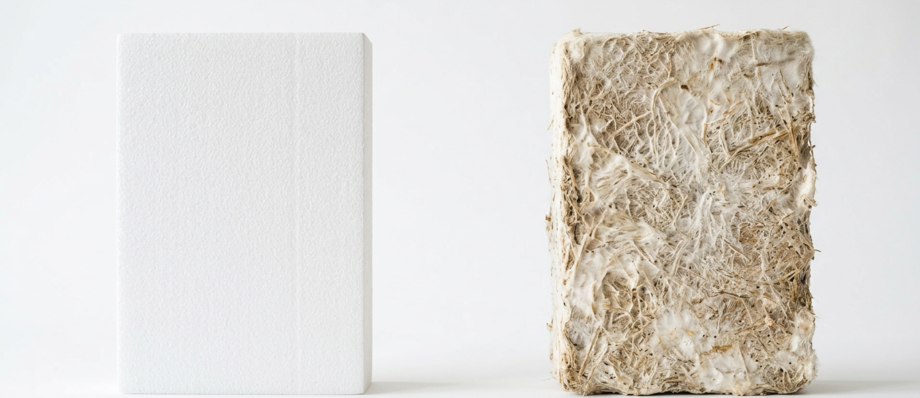
The Scope 3 Collapse of XPS/EPS Foams vs. The Thermal Reality of Mycelium Matrices
Specifying Extruded Polystyrene (XPS) or Expanded Polystyrene (EPS) in architectural blueprints under the justification of “industrial recyclability” is a statistical manipulation. The construction industry continues to envelop buildings in petrochemical foams, driven by high R-values, while ignoring the thermodynamic realities of the material’s end-of-life (EoL) phase.
Architectural material selection should not be based solely on laboratory thermal resistance. It should account for the mechanical stresses of demolition, local regulation, and the lifecycle carbon footprint. When we analyze the physical and chemical data, the greenwashing surrounding conventional rigid foams collapses, revealing a massive Scope 3 emissions liability.
The Volumetric Inefficiency and Scope 3 Burden of EPS/XPS
Conventional rigid foams are composed of roughly 98% trapped air and 2% polystyrene polymer. While this ratio provides excellent insulation during the operational phase of a building, it creates an insurmountable logistical failure at the demolition stage:
- The Recycling Illusion: Because EPS/XPS has an extremely low volume-to-weight ratio, transporting demolished foam boards to specialized recycling facilities generates disproportionate Scope 3 transportation emissions. In most cases, the fossil fuel burned by heavy-duty diesel trucks to transport lightweight, bulky foam miles away exceeds the net carbon offset of recycling the polymer.
- Microplastic Fragmentation: During the mechanical stress of building demolition, aging polystyrene boards do not remain intact. They shatter into millions of unrecoverable microplastic beads that permanently contaminate the topsoil and local groundwater.
- The Toxic Fire Retardant Legacy: To meet stringent fire codes, petrochemical foams have historically been heavily doped with synthetic brominated flame retardants, most notably Hexabromocyclododecane (HBCD). Now classified as a Persistent Organic Pollutant (POP) under global regulations, HBCD makes thermal recycling (incineration) highly toxic, permanently locking post-demolition EPS/XPS into a linear landfill trajectory.
The Physics of Fungi: Engineering Mycelium Matrices
The technical alternative to petrochemical foams exists within Biolisty’s Bio-Foams & Insulation category. By leveraging Fungi/Mycelium as a biological binder, we can lock Lignocellulosic matter (agricultural crop waste like hemp hurd or flax straw) into a rigid thermal matrix.
This is an industrially scalable process that cures in the dark at ambient room temperatures, requiring zero Scope 1 thermal energy and actively sequestering biogenic CO₂ within the structural envelope of the building.
📈 Thermal and Acoustic Performance Metrics
Mycelium insulation panels achieve an impressive thermal conductivity coefficient ($\lambda$) ranging from 0.035 to 0.040 W/m·K. This places the biological matrix in direct engineering competition with standard EPS, providing the exact thermal resistance required for passive house envelopes. Furthermore, the viscoelastic cellular density of the mycelium network yields superior acoustic dampening, significantly outperforming closed-cell petrochemical foams in low-frequency sound absorption.
🔥 Passive Fire Resistance (ASTM E84)
Unlike polystyrene, which melts, collapses, and drips flaming polymers under high heat, mycelium possesses an inherent cellular defense. The cell walls of the Fungi/Mycelium network are composed of chitin—the same resilient biopolymer found in crustacean shells.
When exposed to direct flame, the chitin matrix undergoes a natural charring effect. This carbonized outer layer acts as an insulative thermal barrier, preventing flame spread and allowing these bio-panels to meet stringent Class A fire ratings (ASTM E84) without the injection of a single synthetic or toxic flame retardant.
💧 Engineering the Moisture Barrier (Hydrophobic Behavior)
While lignocellulosic cores are naturally hydrophilic, modern bio-material engineering overcomes this limit without compromising circularity. To compete with the zero-moisture absorption of XPS, mycelium matrices are engineered with natural pozzolans or post-treated with bio-based, breathable vapor-permeable sealants from the Bio-Finishes & Coatings category (such as natural silicate or plant-wax emulsions). This prevents water uptake while maintaining the building’s passive vapor breathability.
Site Reality: Eradicating Demolition Waste in Dynamic Zones
In dynamic climatic and sismically active zones where the building stock is frequently upgraded, retrofitted, or demolished, the demolition phase defines a material’s true lifecycle cost. Industrial recycling—melting plastics in energy-intensive plants—is a flawed crutch for poorly designed materials.
Mycelium matrices operate on a fundamentally different EoL protocol. Because they consist entirely of agricultural waste bound by fungal chitin, they are devoid of toxic adhesives, formaldehydes, or microplastics.
Upon demolition, mycelium panels eliminate the Scope 3 transport burden entirely. They fall strictly into Biolisty’s On-Site Mulchable and Home Compostable parameters:
- Zero Transportation: The panels can be mechanically crushed directly on the construction site.
- Soil Integration: The shredded debris can be safely integrated into the surrounding soil.
- Passive Regeneration: Instead of generating hazardous waste removal fees, the material naturally breaks down into a nitrogen-rich soil amendment within 45 to 60 days.
A building envelope that requires energy-intensive industrial facilities to manage its post-demolition waste is an environmental and financial liability. By substituting XPS/EPS with pure mycelium matrices, engineers transition from managing petrochemical liabilities to specifying self-extinguishing, high-performance bio-composites that treat the soil as their final, passive recycling facility. Architecture must operate within the thermodynamic boundaries of the biosphere, and material specification is our first line of defense.