
Biopolymer Glossary & Biodegradability Spectrum
Biopolymer Glossary & Biodegradability Spectrum
Thermodynamic and biological realities behind polymers in the construction and packaging industries. A chief engineering reference decoding how materials actually degrade, the greenwashing behind the “Bio” label, and the ecological End-of-Life (EoL) status of materials.
1. Material & Polymer Definitions
PHA (Polyhydroxyalkanoates)
Absolute CircularityWhat is it made of? A natural intracellular polyester produced by bacterial fermentation of carbon wastes.
It is the most powerful alternative to synthetic PU and epoxies. Not a man-made synthetic plastic, but a bacteria’s energy reserve. Tensile strength ranges from 15-40 MPa.
Biodegradability: 100% (Marine, Soil, Water)
PBAT
Soil DegradableWhat is it made of? An aliphatic-aromatic copolyester synthesized from fossil fuels.
Despite being petroleum-based, its molecular structure is open to enzymatic digestion. Extremely flexible (Elongation at break > 500%).
Biodegradability: 100% (Soil, Home Compost)
PCL (Polycaprolactone)
Soil DegradableWhat is it made of? A fossil-based aliphatic polyester.
Has an exceptionally low melting point of 60°C. This allows it to be thermoformed on-site with low energy.
Biodegradability: 100% (Soil and Water)
PLA (Polylactic Acid)
Logistics DependentWhat is it made of? Obtained by fermenting plant starches (corn, sugarcane, cassava).
Quite rigid and strong (50-70 MPa). If left in a natural environment or ocean, it remains intact just like a standard plastic.
Biodegradability: Industrial Compost Only
Bio-PE, Bio-PET
GreenwashingWhat is it made of? Synthesized from sugarcane or agricultural biomass (Non-fossil).
The carbon source is plant-based, but at the molecular level, it has the exact same covalent bonds as traditional plastics.
Biodegradability: 0% (Non-Biodegradable)
PU, PE, PP, Epoxy
Permanent ToxicityWhat is it made of? 100% Fossil fuels (Crude oil and natural gas).
When combined with organic fibers, they turn them into an irreversible, toxic, monolithic waste.
Biodegradability: 0% (Non-Biodegradable)
2. Biodegradability Spectrum
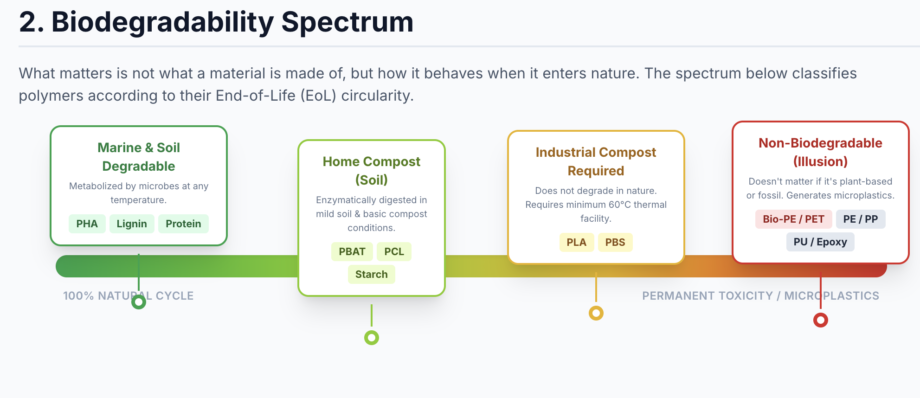
What matters is not what a material is made of, but how it behaves when it enters nature. The spectrum below classifies polymers according to their End-of-Life (EoL) circularity.
Marine & Soil Degradable
Home Compost (Soil)
Industrial Compost
Non-Biodegradable
EoL (End-of-Life) Algorithm for Architects
When selecting a polymer, asking “Is it bio-based?” is misleading. The correct engineering question is: “If I throw this into the ocean or the soil on-site, is there a bacteria that can eat it?” If your answer is “Yes” like PHA, it is absolutely circular. If it is “Only in a 60-degree oven” like PLA, it is a logistical burden. If it is “No” like Bio-PET, it is toxic waste.
ExoWatts
July 17, 2026Great content! Keep up the good work!
marjanitallc@gmail.com
July 18, 2026Thank you… 🙏