Navigating the New Era of Circular Economy: A Comprehensive Guide to Regulation (EU) 2025/40 on Packaging and Packaging Waste
The European Union has set in motion one of the most ambitious environmental legislations in its history: Regulation (EU) 2025/40 on packaging and packaging waste [Article 1][1]. Adopted on December 19, 2024 [Article 1][1], and replacing the outdated Directive 94/62/EC [Recital 187][2], this legally binding Regulation unifies packaging rules across all Member States to create a seamless, low-carbon circular economy [Article 1(2)][3].
With the official application date set for August 12, 2026 [Article 71][4], businesses operating within or exporting to the EU must quickly adapt to these stringent and highly detailed requirements. In this comprehensive guide, we dissect the regulation’s core pillars, including the upcoming restrictions on hazardous substances, strict packaging minimisation mandates for e-commerce, and the massive operational shift expected in logistics and supply chain systems.
1. The Impetus Behind the Regulation: A Waste Crisis
Packaging waste is one of the fastest-growing environmental challenges in Europe. According to Eurostat statistics, packaging represents a staggering 36% of municipal solid waste in the Union [Recital 2][5]. Furthermore, packaging is a primary consumer of resources, utilizing 40% of plastics and 50% of paper in the EU [Recital 2][5]. High volumes of single-use designs, low rates of re-use, and poor recycling systems have historically blocked transition to a low-carbon circular economy [Recital 2][5]. Regulation (EU) 2025/40 tackles these failures by addressing the entire life-cycle of packaging—from design and manufacturing to retail, logistics, and end-of-life management [Article 1(1)][6].
2. Quantitative Waste Prevention Targets
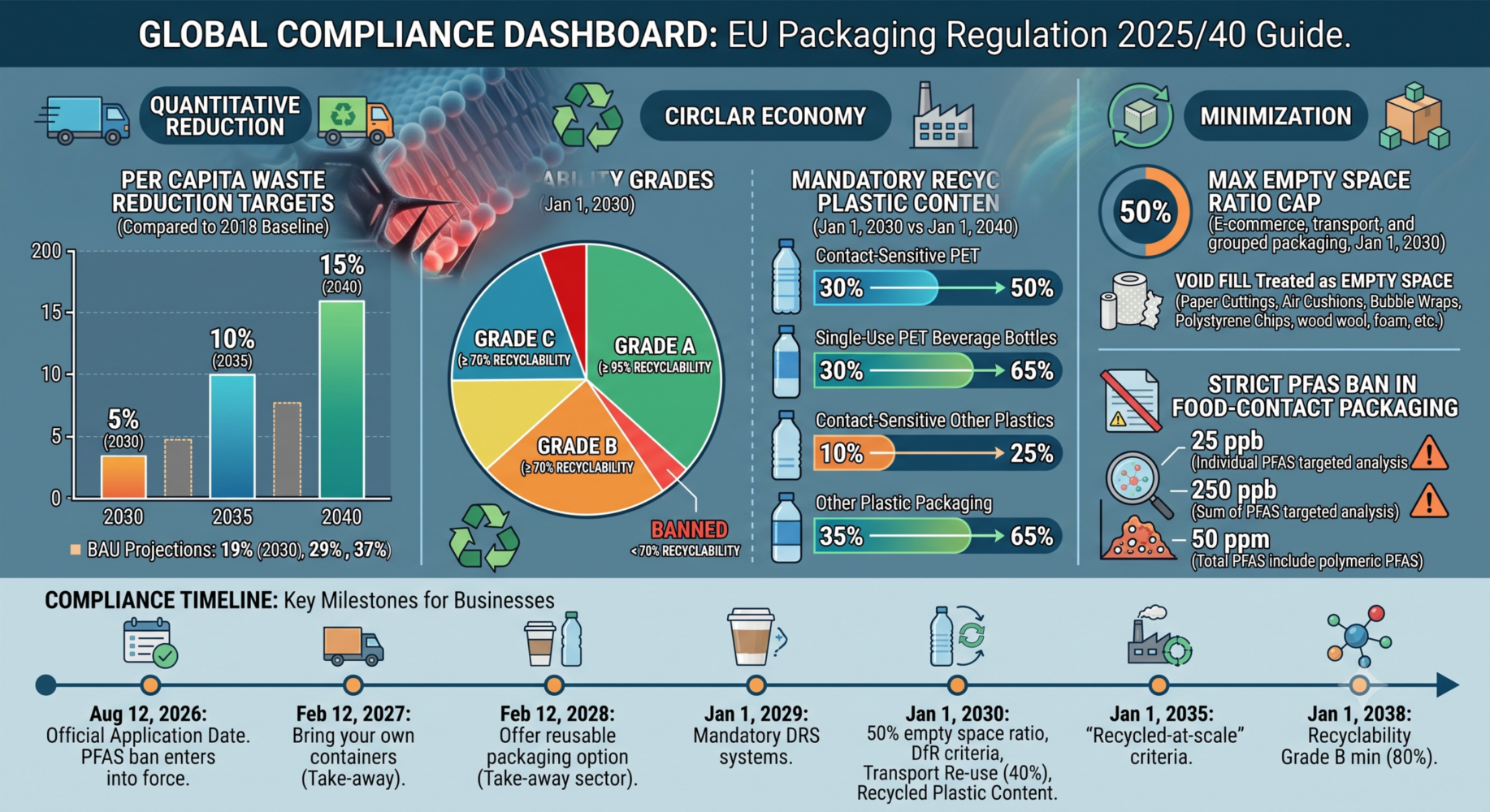
To curb the absolute volume of packaging entering the market, the EU has set binding packaging waste reduction targets per capita for each Member State, measured against a 2018 baseline [Article 43(1)][7]:
- 5% reduction by 2030 [Article 43(1)(a)][8] (equivalent to an absolute 19% reduction compared to the 2030 business-as-usual projection [Recital 120][9]).
- 10% reduction by 2035 [Article 43(1)(b)][10] (a 29% reduction compared to the 2035 baseline projection [Recital 120][9]).
- 15% reduction by 2040 [Article 43(1)(c)][11] (a 37% reduction compared to the 2040 baseline projection [Recital 120][9]).
Member States must implement domestic waste prevention measures, including economic incentives and expanded producer responsibility (EPR) policies, with a particular focus on reducing plastic packaging waste [Article 43(4)-(5)][12].
3. Recyclability & Recycled Content Mandates
From January 1, 2030, all packaging placed on the EU market must be recyclable [Article 6(1)][13]. Packaging recyclability will be graded under three Recyclability Performance Grades based on Design for Recycling (DfR) criteria [Article 6(3) & Annex II, Table 3][14]:
- Grade A (≥ 95% recyclability) [Annex II, Table 3][15]
- Grade B (≥ 80% recyclability) [Annex II, Table 3][15]
- Grade C (≥ 70% recyclability) [Annex II, Table 3][15]
Any packaging unit performing below Grade C (< 70%) will be classified as technically non-recyclable and banned from the market [Article 6(3) & Annex II, Table 3][16]. From January 1, 2038, the minimum entry-level recyclability threshold rises to Grade B (80%) [Article 6(3)][17]. Furthermore, from January 1, 2035, a new “recycled-at-scale” criteria will be integrated into these grades, ensuring packaging is not just theoretically recyclable but effectively collected, sorted, and processed into high-quality secondary raw materials at a commercial scale [Article 6(2)(b) & Annex II, Table 3][18].
Mandatory Recycled Content in Plastics (January 1, 2030)
To establish a strong market for secondary plastics, any plastic part of packaging must contain a minimum percentage of recycled content recovered from post-consumer plastic waste [Article 7(1)][19]:
- 30% for contact-sensitive PET packaging (except beverage bottles) [Article 7(1)(a)][20].
- 10% for other contact-sensitive plastics (except PET and beverage bottles) [Article 7(1)(b)][21].
- 30% for single-use plastic beverage bottles [Article 7(1)(c)][22].
- 35% for general plastic packaging other than contact-sensitive formats [Article 7(1)(d)][23].
By January 1, 2040, these percentages will scale drastically, reaching 50% for contact-sensitive PET, 25% for other contact-sensitive plastics, and 65% for plastic beverage bottles and other plastic packaging [Article 7(2)(a)-(d)][24].
4. Deep Dive: The Strict PFAS Ban in Food-Contact Packaging
One of the most immediate and critical chemical restrictions in this regulation targets per- and polyfluoroalkyl substances (PFAS) [Article 5(5)][25]. Food-contact packaging has historically been a significant source of human exposure to these highly persistent “forever chemicals” [Recital 20][26]. Due to their absolute persistence and severe long-term health risks—including carcinogenicity, mutagenicity, reproductive toxicity, and target organ toxicity—the EU has established an absolute prohibition [Recital 20][26].
Starting August 12, 2026, food-contact packaging containing PFAS above the following strict concentration limits cannot be placed on the market [Article 5(5)][25]:
- 25 ppb (parts per billion) for any individual PFAS as measured by targeted analysis (excluding polymeric PFAS from quantification) [Article 5(5)(a)][27].
- 250 ppb for the sum of PFAS measured by targeted analysis, including prior degradation of precursors [Article 5(5)(b)][28].
- 50 ppm (parts per million) for PFASs including polymeric PFAS [Article 5(5)(c)][29].
If total fluorine exceeds 50 mg/kg, the manufacturer or importer must provide documentation identifying whether the fluorine originates from PFAS or non-PFAS compounds to complete their mandatory technical dossiers [Article 5(5)(c)][29]. The European Commission is scheduled to evaluate this restriction by August 12, 2030, to prevent regulatory overlap with potential broader bans under REACH or persistent organic pollutant frameworks [Article 5(5) last subpara][30].
5. Deep Dive: Packaging Minimisation & The 50% Empty Space Rule in E-Commerce
For years, consumers have complained about receiving small e-commerce deliveries in excessively large boxes filled with plastic air cushions. Under the new Regulation, this practice is officially coming to an end.
The Minimisation Mandate (January 1, 2030)
By January 1, 2030, all packaging placed on the market must be designed so its weight and volume are reduced to the absolute minimum necessary to ensure product safety, hygiene, and functionality [Article 10(1)][31]. Manufacturers must conduct strict performance assessments and document them in their technical files [Article 10(4) & Annex VII][32]. Packaging featuring double walls, false bottoms, unnecessary layers, or superfluous packaging designed solely to increase the perceived volume of a product is strictly prohibited [Article 10(2)][33].
The 50% Empty Space Limit for E-Commerce and Transport Packaging
For grouped, transport, and e-commerce packaging supplied to final distributors or end-users, the maximum empty space ratio is capped at 50% [Article 24(1)][34]:
- Empty Space Defined: Legally, empty space is the difference between the total volume of the grouped, transport, or e-commerce packaging and the volume of the sales packaging contained within [Article 24(3)][35].
- Void Fill is Treated as Empty Space: Crucially, space filled with loose materials such as paper cuttings, air cushions, bubble wraps, sponge fillers, foam fillers, wood wool, or polystyrene/Styrofoam chips is legally considered empty space [Article 24(3)(b)][36]. Businesses cannot circumvent the 50% limit by packing boxes with plastic void fill [Article 24(3)(b)][36].
- Calculation & Exemptions: By February 12, 2028, the Commission will publish the exact calculation methodology, allowing for certain protections of irregularly shaped items [Article 24(2)][37]. Importantly, economic operators using sales packaging as e-commerce packaging, or participating in reusable packaging networks, are exempt from this 50% empty space rule, though they must still comply with general packaging minimisation guidelines [Article 24(5)][38].
6. Deep Dive: Major Disruptions in Logistics & Supply Chain Operations
Regulation (EU) 2025/40 will trigger a massive operational shift across supply chains, introducing new compliance hurdles for logistics providers and third-party platforms.
Mandatory Re-use Targets for Transport Packaging (Article 29)
From January 1, 2030, economic operators using transport packaging (including pallets, plastic crates, boxes, trays, intermediate bulk containers [IBCs], pails, drums, and canisters) must ensure that at least 40% of such packaging is reusable within an active re-use system [Article 29(1)][39]. This target rises to 70% by 2040 [Article 29(1) second subpara][40].
Even more strictly, the regulation mandates 100% reusable transport packaging from January 1, 2030, for shipments [Article 29(2) & (3)][41]:
- Between different sites operated by the same company [Article 29(2)][42].
- Between linked or partner enterprises [Article 29(2)][42].
- For intra-state logistics (shipments to another economic operator within the same EU Member State) [Article 29(3)][43].
Cardboard boxes, packaging for dangerous goods, and custom-designed packaging for large machinery are exempted from these re-use targets [Article 29(4)][44].
EPR Obligations and the New Liability of “Logistics Companies”
To prevent regulatory evasion (free-riding), the regulation clarifies the definition of the “producer” under the Extended Producer Responsibility (EPR) registry [Article 3(1) point (15)(e)][45]:
- Logistics Companies as Producers: If a logistics company receives imported goods from third countries, unpacks them, or repacks them into smaller formats to comply with client orders, they are designated as the “producer” for the original transport packaging that came from the third country [Article 3(1) point (15)(e) & Recital 123][45]. Even if they do not hold ownership of the goods, they bear full EPR costs and compliance responsibilities for that packaging waste [Recital 123 & Article 45(1)][46].
- E-Commerce and Fulfilment Service Providers (FSPs): Providers of online marketplaces and FSPs (offering warehousing, packing, or dispatching services) must make “best efforts” to verify that the traders selling packaging on their systems are registered in national EPR registries and comply with the regulations [Article 45(4)-(8) & Recital 132][47]. FSPs must swiftly suspend services to any third-party trader who fails to provide complete, up-to-date EPR registration information [Article 45(8) third subpara][48].
7. Compliance Timeline: Key Milestones for Businesses
To avoid penalties, supply chain interruptions, or product bans, businesses must map their transition strategies against these key legislative dates:
- August 12, 2026: Regulation (EU) 2025/40 officially applies [Article 71][4]. The PFAS ban in food-contact packaging enters into force [Article 5(5)][25].
- February 12, 2027: Take-away food and beverage businesses must establish systems for consumers to bring their own containers (refill) [Article 32(1)][49].
- February 12, 2028: Take-away sector must offer consumers the option of obtaining ready food and drinks in reusable packaging [Article 33(1)][50].
- January 1, 2029: Mandatory Deposit and Return Systems (DRS) must be implemented for single-use plastic beverage bottles and metal cans (with a 90% separate collection target) [Article 50(1) & (2)][51].
- January 1, 2030:
- 50% empty space ratio cap for e-commerce, transport, and grouped packaging [Article 24(1)][34].
- All packaging must comply with DfR recyclability criteria (Grade A, B, or C) [Article 6(3)][17].
- 40% re-use target for general transport packaging (and 100% for internal/partner/domestic transport) [Article 29(1)-(3)][39].
- Minimum recycled plastic content targets apply [Article 7(1)][19].
- January 1, 2035: “Recycled-at-scale” criteria integrated into recyclability grades [Article 6(2)(b)][18].
- January 1, 2038: Technically recyclable packaging must meet at least Recyclability Grade B (80%) [Article 6(3)][17].
Conclusion: Act Now to Secure Your Supply Chain
Regulation (EU) 2025/40 is not a distant policy directive; its application begins on August 12, 2026 [Article 71][4]. From auditing the chemical composition of food packaging to comply with the PFAS ban [Article 5(5)][25], to redesigning shipping cartons to hit the 50% e-commerce empty space rule [Article 24(1)][34], every business linked to the European market must take action. Adapting your supply chain today is no longer just a sustainability goal—it is a baseline requirement for market access [Recital 2][5].
Footnotes
[1]: Regulation (EU) 2025/40, Title & Article 1 (Subject matter): Formally adopted on December 19, 2024, setting out environmental sustainability and packaging waste requirements across the lifecycle.
[2]: Regulation (EU) 2025/40, Recital 187 & Article 70: Explicitly repeals the old Packaging and Packaging Waste Directive 94/62/EC while transitioning to the direct-acting Regulation.
[3]: Regulation (EU) 2025/40, Article 1(2): Establishes the purpose of harmonising national measures to prevent trade obstacles and ensure the functioning of the internal market.
[4]: Regulation (EU) 2025/40, Article 71: Defines the entry into force (20 days post-publication) and the official application date as August 12, 2026.
[5]: Regulation (EU) 2025/40, Recital 2: Cites Eurostat statistics showing packaging accounts for 36% of municipal solid waste, and consumes 40% of plastics and 50% of paper in the Union.
[6]: Regulation (EU) 2025/40, Article 1(1): Outlines that the scope covers the entire life-cycle of packaging.
[7]: Regulation (EU) 2025/40, Article 43(1): Sets out the per capita packaging waste reduction targets compared to the 2018 base year.
[8]: Regulation (EU) 2025/40, Article 43(1)(a): Prescribes the binding target of at least 5% packaging waste reduction by 2030.
[9]: Regulation (EU) 2025/40, Recital 120: Translates per capita targets into estimated absolute reductions of 19%, 29%, and 37% against respective baseline projections.
[10]: Regulation (EU) 2025/40, Article 43(1)(b): Prescribes the binding target of at least 10% packaging waste reduction by 2035.
[11]: Regulation (EU) 2025/40, Article 43(1)(c): Prescribes the binding target of at least 15% packaging waste reduction by 2040.
[12]: Regulation (EU) 2025/40, Article 43(4)-(5): Commits Member States to target plastic packaging waste specifically and employ EPR and financial incentives.
[13]: Regulation (EU) 2025/40, Article 6(1): Directs that all packaging placed on the EU market must be recyclable.
[14]: Regulation (EU) 2025/40, Article 6(3) & Annex II, Table 3: Sets out the grading system (Grades A, B, C) for recyclability based on Design for Recycling (DfR) criteria.
[15]: Regulation (EU) 2025/40, Annex II, Table 3: Specifies Grade A as ≥ 95%, Grade B as ≥ 80%, and Grade C as ≥ 70% recyclability.
[16]: Regulation (EU) 2025/40, Article 6(3) & Annex II, Table 3: Declares packaging performing below Grade C (< 70%) as technically non-recyclable and banned.
[17]: Regulation (EU) 2025/40, Article 6(3): Dictates that from January 1, 2038, the entry threshold rises to Recyclability Grade B (80%).
[18]: Regulation (EU) 2025/40, Article 6(2)(b) & Annex II, Table 3: Introduces the “recycled-at-scale” (RaS) requirement from January 1, 2035.
[19]: Regulation (EU) 2025/40, Article 7(1): Mandates minimum recycled content in plastic packaging from post-consumer plastic waste by January 1, 2030.
[20]: Regulation (EU) 2025/40, Article 7(1)(a): Defines 30% minimum recycled content for PET major-component contact-sensitive packaging.
[21]: Regulation (EU) 2025/40, Article 7(1)(b): Defines 10% minimum recycled content for non-PET contact-sensitive plastics.
[22]: Regulation (EU) 2025/40, Article 7(1)(c): Defines 30% minimum recycled content for single-use plastic beverage bottles.
[23]: Regulation (EU) 2025/40, Article 7(1)(d): Defines 35% minimum recycled content for general other plastic packaging.
[24]: Regulation (EU) 2025/40, Article 7(2)(a)-(d): Scales 2040 minimum recycled plastic content requirements to 50% (sensitive PET), 25% (other sensitive), 65% (beverage bottles), and 65% (other general).
[25]: Regulation (EU) 2025/40, Article 5(5): Specifically prohibits food-contact packaging containing PFAS above limit values from August 12, 2026.
[26]: Regulation (EU) 2025/40, Recital 20: Details health risks of PFAS (carcinogenicity, mutagenicity, reproductive toxicity) and identifies food-contact packaging as a primary exposure sector.
[27]: Regulation (EU) 2025/40, Article 5(5)(a): Sets a limit of 25 ppb for individual PFAS measured by targeted analysis.
[28]: Regulation (EU) 2025/40, Article 5(5)(b): Sets a limit of 250 ppb for the sum of PFAS including prior degradation of precursors.
[29]: Regulation (EU) 2025/40, Article 5(5)(c): Sets a limit of 50 ppm for total PFAS (including polymeric). Total fluorine above 50 mg/kg requires documentation.
[30]: Regulation (EU) 2025/40, Article 5(5) last subparagraph & Recital 21: Requires a review by August 12, 2030, to ensure coherence with broader REACH chemical restrictions.
[31]: Regulation (EU) 2025/40, Article 10(1): Mandates manufacturers and importers to design packaging to minimize weight and volume by January 1, 2030.
[32]: Regulation (EU) 2025/40, Article 10(4) & Annex VII: Requires performance criteria compliance to be kept in technical documentation under Module A.
[33]: Regulation (EU) 2025/40, Article 10(2): Bans characteristics solely aimed at increasing perceived product volume, such as double walls and false bottoms.
[34]: Regulation (EU) 2025/40, Article 24(1): Sets the maximum empty space ratio to 50% for grouped, transport, and e-commerce packaging by January 1, 2030.
[35]: Regulation (EU) 2025/40, Article 24(3): Defines empty space as the total packaging volume minus the sales packaging volume.
[36]: Regulation (EU) 2025/40, Article 24(3)(b): Explicitly treats any space filled by void fillers (bubble wrap, air cushions, etc.) as legally empty space.
[37]: Regulation (EU) 2025/40, Article 24(2): Tasks the Commission to establish a calculation methodology by February 12, 2028, reflecting protection requirements of irregular items.
[38]: Regulation (EU) 2025/40, Article 24(5): Exempts e-commerce shipments where sales packaging itself is the outer mailer, or which operate in reusable systems.
[39]: Regulation (EU) 2025/40, Article 29(1): Sets a minimum 40% re-use target for transport packaging formats by January 1, 2030.
[40]: Regulation (EU) 2025/40, Article 29(1) second subparagraph: Raises the transport packaging re-use target to 70% by January 1, 2040.
[41]: Regulation (EU) 2025/40, Article 29(2) & (3): Mandates 100% reusable transport packaging for internal corporate, partner site, and intra-state B2B shipments.
[42]: Regulation (EU) 2025/40, Article 29(2): Applies the 100% reusable target to transport between sites of the same company or partner enterprises.
[43]: Regulation (EU) 2025/40, Article 29(3): Applies the 100% reusable target to intra-state B2B shipments within the same Member State.
[44]: Regulation (EU) 2025/40, Article 29(4): Exempts cardboard boxes, packaging for dangerous goods, and customized machine wrappers.
[45]: Regulation (EU) 2025/40, Article 3(1) point (15)(e) & Recital 123: Classifies logistics companies as “producers” for packaging imported from third countries that they unpack or repack.
[46]: Regulation (EU) 2025/40, Recital 123 & Article 45(1)-(2): Places the financial and organizational EPR obligations on logistics operators handling third-country imports.
[47]: Regulation (EU) 2025/40, Article 45(4)-(8) & Recital 132: Obligates online platforms and FSPs to obtain self-certifications and verify EPR registry records.
[48]: Regulation (EU) 2025/40, Article 45(8) third subparagraph: Mandates FSPs to suspend warehousing and packing services to traders failing to verify EPR registration.
[49]: Regulation (EU) 2025/40, Article 32(1): Mandates HORECA takeaway operators to establish customer bring-your-own-container systems by February 12, 2027.
[50]: Regulation (EU) 2025/40, Article 33(1): Requires HORECA takeaway operators to offer a reusable packaging option by February 12, 2028.
[51]: Regulation (EU) 2025/40, Article 50(1) & (2): Requires deposit-return systems for metal cans and single-use plastic bottles under 3L to reach 90% separate collection by January 1, 2029.