A Comprehensive Guide to Regulation (EU) 2025/40 on Packaging and Packaging Waste
Regulation (EU) 2025/40
Packaging and Packaging Waste – Circular Economy Guide
Legally binding rules replacing Directive 94/62/EC across all Member States.
Official Application Date
August 12, 2026
Applies to all EU Member States
The Impetus: A Waste Crisis
Packaging’s share in total EU waste
EU plastic used by packaging sector
EU paper used by packaging sector
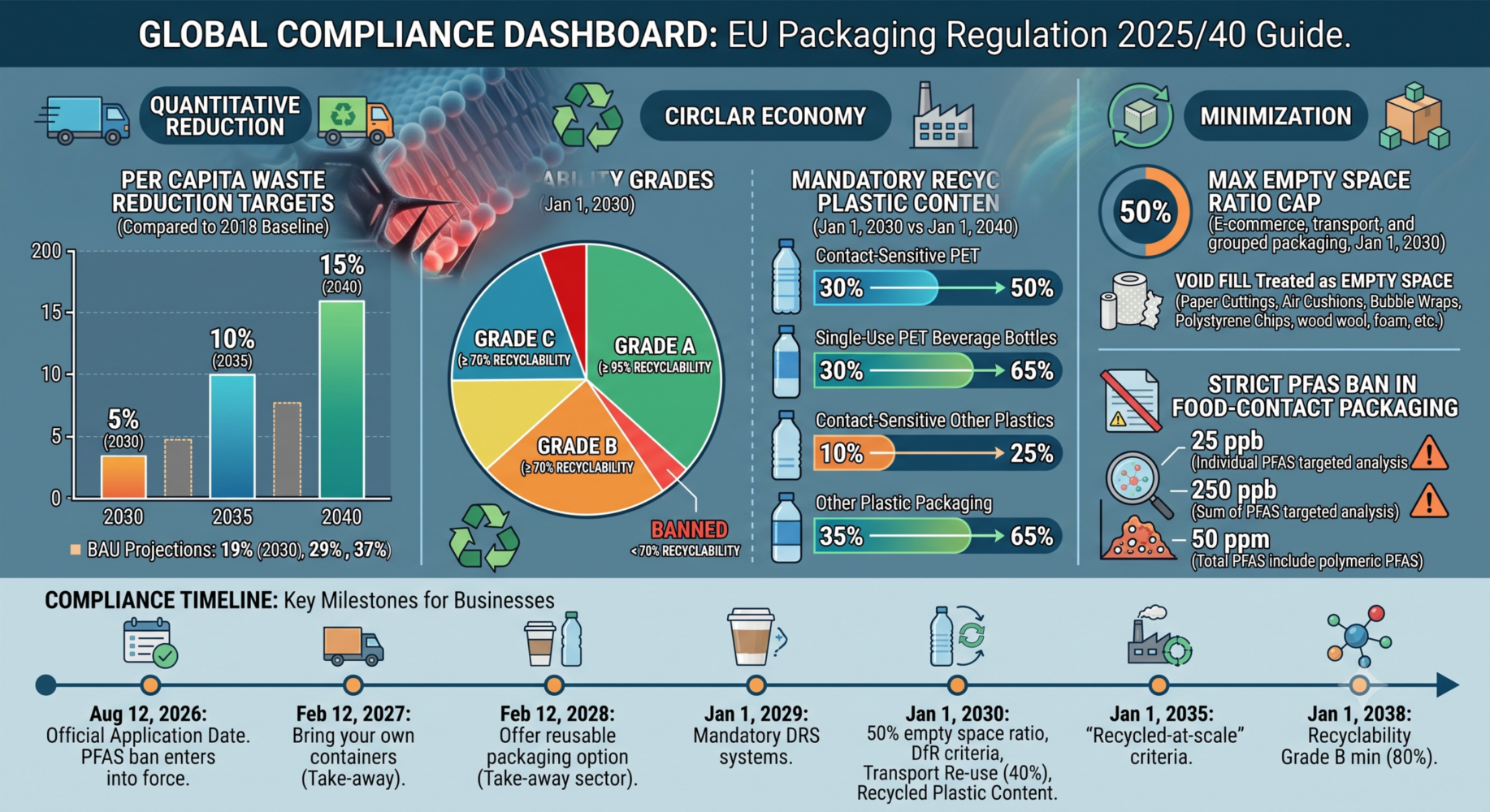
Quantitative Waste Prevention Targets (Per Capita)
Binding volume reduction targets measured against a 2018 baseline.
Recyclability Performance Grades
DfR Criteria (Applies to all packaging)
| Grade | Recyclability % | Status (Jan 1, 2030) |
|---|---|---|
| Grade A | ≥ 95% | Accepted |
| Grade B | ≥ 80% | Accepted Min. entry threshold by Jan 1, 2038. |
| Grade C | ≥ 70% | Accepted |
| Non-Recyclable | < 70% | BANNED FROM MARKET |
Mandatory Recycled Plastic Content
Minimum percentage from post-consumer plastic waste
Strict PFAS Ban
In food-contact packaging (“Forever Chemicals”).
Applies: Aug 12, 2026
*If total fluorine exceeds 50 mg/kg, documentation is required to identify if the origin is PFAS or non-PFAS compounds.
E-Commerce & 50% Void Limit
Packaging Minimisation
Applies: Jan 1, 2030
- Grouped, transport, and e-commerce packaging empty space capped at 50%.
- *Critical: Paper cuttings, air cushions, bubble wraps, sponge/foam fillers, or polystyrene are legally considered empty space (void fill).
- Double walls, false bottoms, and superfluous layers are prohibited.
Logistics & EPR Obligations
Transport Packaging and Liability
Applies: Jan 1, 2030
Logistics companies repacking goods from third countries are designated as the “producer” for the original packaging and bear EPR costs.
Fulfilment Service Providers (FSPs) must suspend services to traders lacking valid EPR registration.
Critical Compliance Milestones
August 12, 2026
Regulation Officially Applies
Aug 12, 2026
Reg (EU) 2025/40 officially enters into force.
The strict PFAS ban in food-contact packaging applies immediately.
Feb 12, 2027 / 2028
Take-away Sector Refill Options
Feb 12, 2027/28
2027: Systems established for consumers to bring own containers.
2028: Take-away sector must offer reusable packaging options.
January 1, 2029
Deposit Return Systems (DRS)
Jan 1, 2029
Mandatory DRS for single-use plastic bottles and metal cans.
Target: 90% separate collection rate.
January 1, 2030
The Big Shift
Jan 1, 2030
- ✔️ 50% empty space cap in e-commerce/transport packaging.
- ✔️ Mandatory DfR Recyclability criteria (Min Grade C).
- ✔️ 40% re-use target for general transport packaging.
- ✔️ Minimum recycled content mandates in plastics apply.
2035 & 2038
Tightening Standards
2035 & 2038
Jan 1, 2035: “Recycled-at-scale” criteria integrated.
Jan 1, 2038: Minimum entry-level threshold rises to Grade B (80%).
Adapting your supply chain today is no longer just a sustainability goal—it is a baseline requirement for market access.
For a detailed breakdown of the targets, timelines, and exemptions, check out the full comprehensive guide published on our blog:
🔗 Read the Full Comprehensive Guide