
The New EU Packaging and Packaging Waste Regulation (PPWR) 2026: Critical Changes for Brands and Exporters
If you are a manufacturer, e-commerce brand, or packaging designer supplying the European market, brace yourself for a legal shift that will completely change how you operate. In line with its 2050 climate neutrality and circular economy goals, the European Union has announced its strictest rulebook yet: the Packaging and Packaging Waste Regulation – PPWR (2025/40).
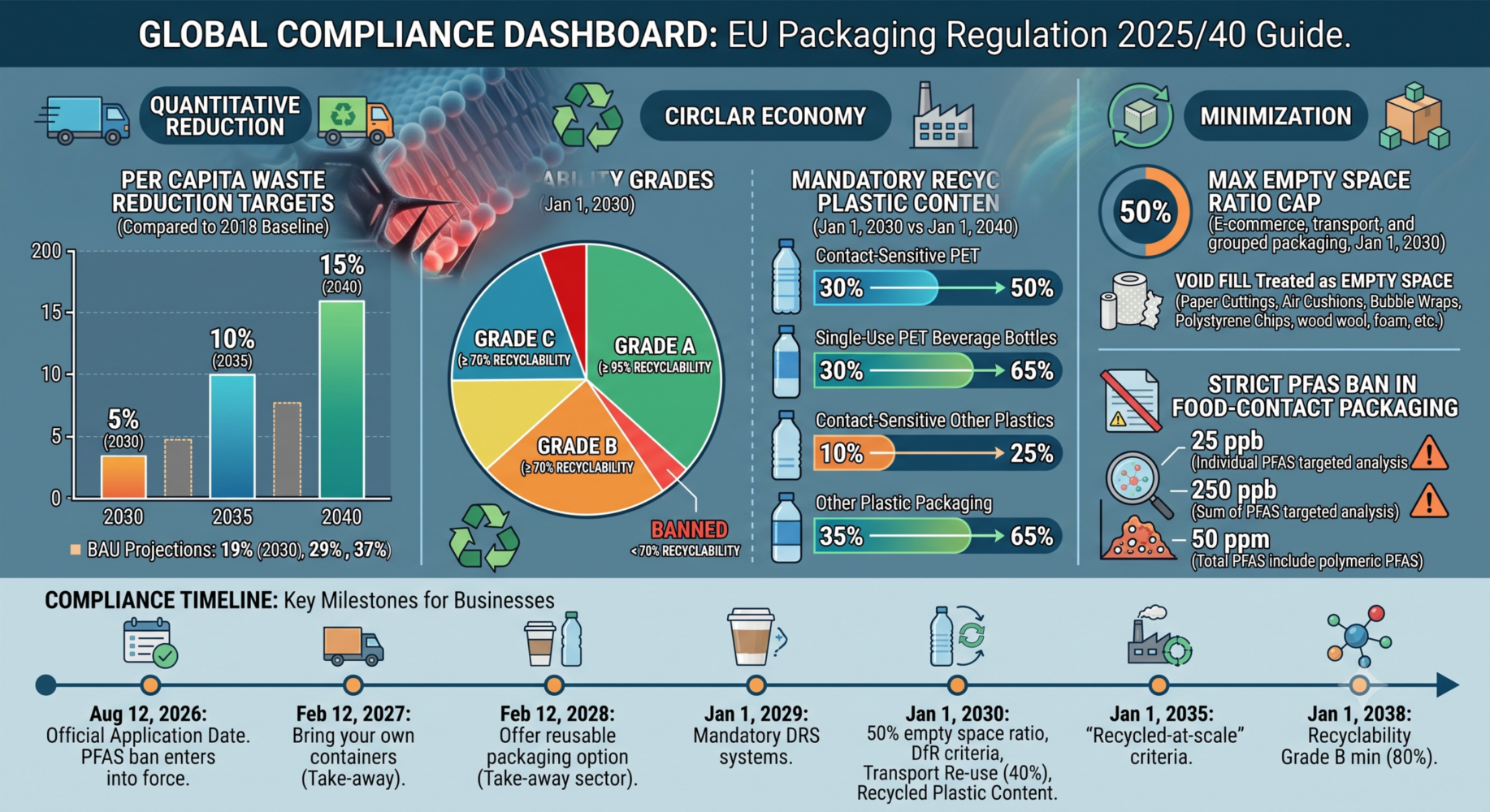
Officially entering into force on February 11, 2025, this regulation gives businesses a very short window to adapt, with the general application starting on August 12, 2026. So, what exactly does this new regulation summary (official EUR-Lex source), which consigns the old 94/62/EC directive to history, mean for B2B companies and brands?
Here are the most critical technical details you need to know:
1. All Packaging Must Be Recyclable “At Scale”
Under the new law, packaging must be recyclable not just in laboratory settings, but in the real world.
- All packaging must be designed for material recycling from the ground up.
- By 2035, it will be legally mandatory for packaging to be collected, sorted, and recycled at an industrial scale.
- Additionally, plastic packaging must contain a minimum percentage of recycled content recovered from post-consumer waste (with a few exceptions, such as packaging for pharmaceuticals, baby food, and hazardous goods).
2. Strict Ban on “Deceptive” Packaging Designs (The Empty Space Rule)
One of the most disruptive rules for e-commerce and logistics companies is the strict volume restriction:
- Maximum 50% Empty Space: By 2030, the “empty space” within grouped, transport, and e-commerce packaging cannot exceed 50%.
- Double Walls and False Bottoms Banned: Designs that attempt to make a product’s volume or size appear larger than it actually is (such as double-walled jars frequently used in the cosmetics industry or false bottoms) are strictly prohibited unless protected by intellectual property design rights or trademarks.
3. Massive Cuts to Single-Use Plastics in HoReCa
Radical bans are coming for the Hotel, Restaurant, and Cafe (HoReCa) sectors, as well as general retail. The following formats are completely eliminated:
- Plastic packaging for pre-packed fresh fruit and vegetables weighing less than 1.5 kg.
- Small, single-use cosmetics and toiletry bottles used in hotels.
- Individual portions of condiments, sauces, coffee creamer, and sugar in restaurants and cafes.
- Single-use shrink films used to group goods at the point of sale to encourage consumers to buy in bulk.
4. “Bring Your Own” (BYO) and Reuse Targets
Takeaway restaurants and e-commerce giants are now forced to redesign their delivery logistics:
- By 2027, all takeaway businesses must allow customers to bring their own containers (BYO) at no additional cost.
- By 2028, these businesses must offer reusable packaging as an alternative for takeaway items.
- 2030 Targets: Beverage distributors must ensure 10% of their products are in reusable packaging, while 40% of all transport packaging must be reusable.
5. Extended Producer Responsibility (EPR) and EU Declaration of Conformity
Simply manufacturing or importing a product will no longer be enough. All producers and importers placing products on the EU market must:
- Issue an EU Declaration of Conformity proving their packaging meets the new regulation’s requirements and retain the technical documentation for 5 to 10 years.
- Pay waste management fees that are “modulated” based on the packaging’s eco-design and recyclability performance. This means environmentally optimized packaging will incur lower fees, while non-compliant or hard-to-recycle designs will face heavy financial burdens.
Securing Your Supply Chain Through Biolisty
As explicitly stated in the European Commission’s PPWR summary text: “Member States may require compostability for specific packaging types if appropriate infrastructure exists.” This makes certified biomaterials—such as industrial compostable and marine biodegradable polymers (like PHA)—your safest haven within this new chain of laws. By utilizing the Biolisty platform, B2B buyers can connect with verified biomaterial producers who have passed rigorous third-party certification audits, ensuring that their supply chains remain entirely free from greenwashing and fully compliant with upcoming European regulations.